
Does divorce harm children?
What harms children most is not the separation itself, but being caught in ongoing conflict between the adults they love. When parents keep conflict away from children, most children adjust well over time.
Shouting, cold silences, criticising the other parent, or using children as messengers all leave a mark. This is not about being friends with your ex. It is about protecting your children from the fight.
How do I tell my children we are getting divorced?
Together if at all possible, at a calm time, with time afterwards to be with them. Keep blame, legal details and adult reasons out of it, and focus on what will change and what will stay the same.
You might say: “We’ve decided we’re going to live in different homes. This is a grown-up decision and it is not because of anything you did or didn’t do. We both love you very much, and that will never change. Some things will be different, and lots of things will stay the same. You can ask us anything, today or whenever you want.” Children usually ask practical questions first, because clarity reduces anxiety. Answer honestly and simply, and if you don’t know yet, say so.
How do children react to divorce at different ages?
It varies with temperament and age. Under-fives may become clingy or regress; five to eights often feel sad and worry they caused it; nine to twelves may be angry and take sides; teenagers may withdraw or grow up too fast.
What helps also changes with age: routine and comfort for the youngest, repeated reassurance that it is not their fault for young children, room for anger without punishing the feeling for older children, and space but closeness for teenagers, without leaning on them as your confidant.
How do I keep my children out of the middle?
Speak about the other parent with respect, or at least neutrally, talk to them directly about arrangements, and keep handovers short, calm and warm.
A loyalty conflict, feeling they must choose or protect one parent, is one of the heaviest burdens a child can carry. Let them take photos and belongings between homes. Never use them as messengers or ask them to report back. Treat co-parenting like a business relationship, where the business is your children’s wellbeing.
Is divorce a kind of grief?
Yes. Psychologically it involves many losses at once, for children and for you: a family shape, a home, routines, and a future you had pictured.
These are real losses, even when the decision was right, and even when it was yours. Divorce is one of the invisible losses nobody sends flowers for. You cannot be a steady anchor for your children if you are running on empty, so process your feelings away from them, with friends, a support group or a therapist.
When should I get extra help for my child?
Talk to your GP, school or a child psychologist if, after several weeks, your child seems persistently low or anxious, stops eating or sleeping well, withdraws from friends, struggles badly at school, or talks about hurting themselves.
Children and young people can talk to Childline any time on 0800 1111. If anyone is not safe, call 999; the National Domestic Abuse Helpline is free and open 24 hours on 0808 2000 247.
When should I get more support?
Grief is not an illness, and there is no deadline for it. But please reach out to your GP or a therapist if you can barely manage day to day, or if you have thoughts of not wanting to be alive. You can call Samaritans free, day or night, on 116 123, and Cruse Bereavement Support on 0808 808 1677. In an emergency, call 999. At The Grief Clinic, our Grief Circles and one-to-one therapy are here too.
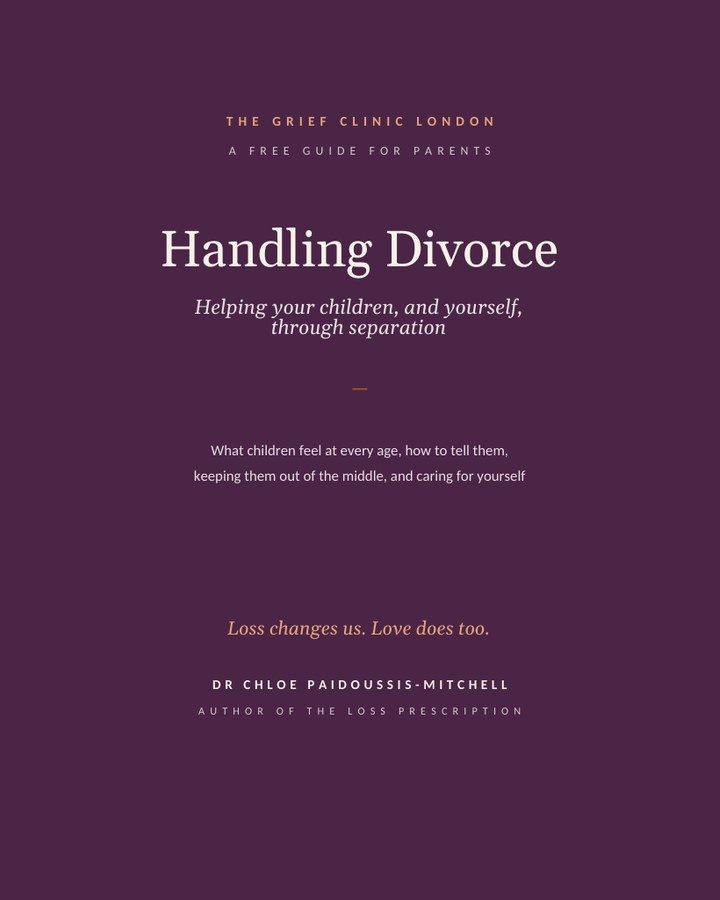
The free guide: Handling Divorce: A Guide for Parents
Handling Divorce: A Guide for Parents is free: what children feel at every age, seven emotional states, a checklist and planning page for telling them, keeping them out of the middle, conversation starters, looking after yourself, and where to get help.
By Dr Chloe Paidoussis-Mitchell, Chartered Counselling Psychologist (DCPsych, CPsychol, AFBPsS), founder of The Grief Clinic London and author of The Loss Prescription (HarperCollins). This page offers general information and is not a substitute for individual psychological care.