
Can you grieve when no one has died?
Yes. Grief is not measured by whether someone died, or by whether others understand. It is measured by what something meant to you. If it mattered, its loss matters.
A marriage ends. A pregnancy ends. A diagnosis changes everything. A career, a country, a parent who is still alive but no longer the person they were. I call these invisible losses, and they are some of the most painful of all, precisely because they are so rarely acknowledged.
What is disenfranchised grief?
It is grief that is not openly acknowledged, socially supported or publicly mourned. The loss is real, but the world around you doesn’t recognise your right to grieve it.
The grief researcher Kenneth Doka named it in 1989. We live with a hierarchy of grief, where some losses are seen as “real” and others are expected to be shrugged off. So people carry them alone, often telling themselves they have no right to feel so much.
What counts as an invisible loss?
Invisible losses tend to fall into five families: endings that are not deaths, losses that are still happening, losses of what never was, losses of self, and losses others don’t count.
- Endings that are not deaths: divorce, a break-up, a friendship ending, leaving a job, a community or a faith.
- Losses that are still happening: a parent with dementia, a loved one with addiction, estrangement. The psychologist Pauline Boss calls this ambiguous loss: someone is here but not here.
- Losses of what never was: infertility, childlessness, the future you had planned.
- Losses of self: your health, your body, your role, your career, your country or language, the person you were.
- Losses others don’t count: miscarriage, the death of a pet, an ex-partner or a colleague.
How do I know if a loss hasn’t been grieved?
Look for five quiet signs: cutting it short, comparing it away, a life story that no longer fits, the body carrying it, and life gone flat.
You might hear yourself saying “I should be over this by now”, or “At least nobody died”, or “I don’t know who I am any more”. You might feel exhausted or tense without knowing why, or be functioning while the colour has drained from things. These are not signs that something is wrong with you. They are signs of a loss still waiting to be recognised.
Why does one loss feel so much bigger than it should?
Because a single loss rarely takes just one thing. It ripples out across your role, your imagined future, your daily structure, the people who witnessed your life, your sense of how life works, and your body.
Writing down everything one loss has taken, across those six parts of a life, can be a relief. It explains why you feel the way you do.
How can I honour a loss nobody else sees?
Name it, tell one person, create a ritual, give it time, and care for the whole of you.
Say it plainly: “I am grieving the end of my marriage.” Tell someone safe: “This has been a real loss for me.” A loss without a funeral still deserves a marker: plant something, write a letter, light a candle on a significant date. And give yourself permission to grieve it fully, without comparing it, rushing it, or apologising for it.
When should I get more support?
Grief is not an illness, and there is no deadline for it. But please reach out to your GP or a therapist if you can barely manage day to day, or if you have thoughts of not wanting to be alive. You can call Samaritans free, day or night, on 116 123, and Cruse Bereavement Support on 0808 808 1677. In an emergency, call 999. At The Grief Clinic, our Grief Circles and one-to-one therapy are here too.
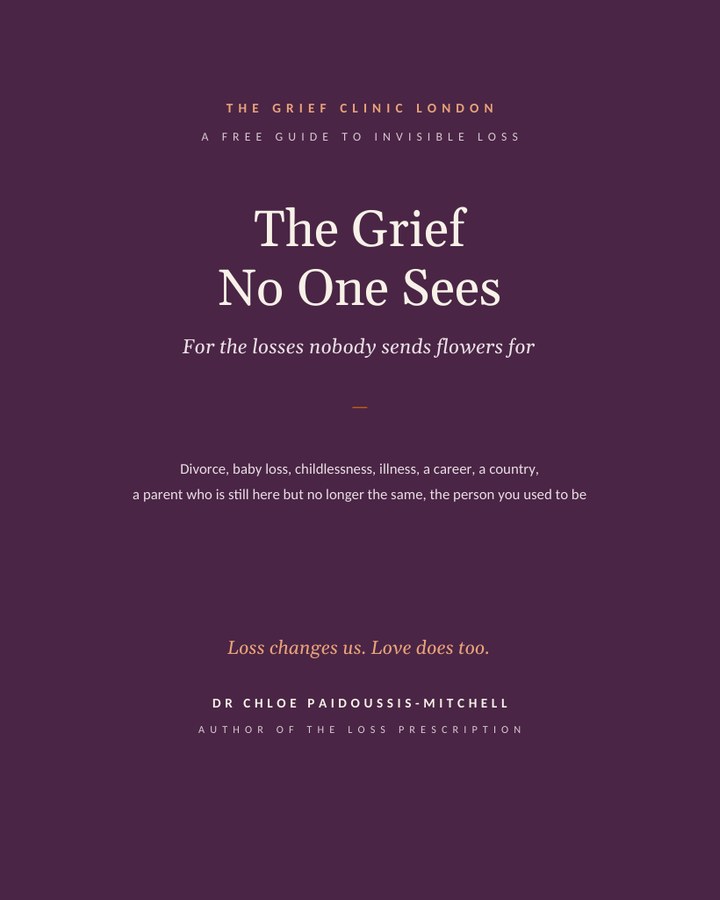
The free guide: The Grief No One Sees
The Grief No One Sees is a free 12-page guide: recognising invisible loss, what makes a loss invisible, five quiet signs a loss has not been grieved, a page to map everything one loss has taken, five ways to give your loss its due, and UK organisations for particular losses.
By Dr Chloe Paidoussis-Mitchell, Chartered Counselling Psychologist (DCPsych, CPsychol, AFBPsS), founder of The Grief Clinic London and author of The Loss Prescription (HarperCollins). This page offers general information and is not a substitute for individual psychological care.