
Is it normal to keep going over a death months later?
Yes. A loss this big cannot be taken in all at once. The mind comes back to it again and again, a little at a time, until it can be borne.
Each time you tell the story, you carry a little more of the reality into your life. The grief researcher Robert Neimeyer describes grieving as slowly rebuilding the story of our lives so that it can hold the loss. Retelling is how that rebuilding happens. It is not a sign you are stuck. It is a sign you are still taking it in.
Why does grief feel like it’s going round in circles?
Because grief moves in a spiral, not up a staircase. You come back to the same place many times, but you are a little different each time you arrive.
The record may sound the same. It is never quite the same song. And not all repetition is the same: what we go over usually falls into one of four places, and each is asking for something different.
What are the four things grief circles back to?
The replay, the if-only, the longing and the what-now.
- The replay (what happened): “I keep seeing the hospital room.” It is asking to be taken in, slowly and safely.
- The if-only (guilt and regret): “I should have noticed.” It is asking for understanding, and forgiveness.
- The longing (missing them): “I miss them more, not less.” It is asking for somewhere for love to go.
- The what-now (the future): “Who am I now?” It is asking for one small, safe step forward.
How do I stop feeling guilty after someone dies?
Start with the hindsight test: write down what you actually knew at the time, not what you know now. Most guilt rests on information we did not have.
If-only thinking is often the mind’s way of avoiding a harder truth: that we could not control what happened. Then speak to yourself as you would to a friend telling you the same story. Some people find it helps to write the apology they wish they had given, and then the reply they believe the person would give, if they could.
What if I keep replaying how they died?
Write the whole story, once, from beginning to end, so your mind can see it has an ending. When images arrive, press your feet into the floor and name five things you can see.
This kind of replay is especially strong after a sudden or traumatic death, or a death you witnessed. If months on the images are vivid, intrusive or frightening, please seek support from someone trained in traumatic grief. It is very treatable.
Where can my story go when people stop asking?
A journal, one trusted person asked directly, the person you lost, a Grief Circle, or therapy.
Our culture is impatient with grief, but the answer is not to silence yourself. People often go quiet because they are afraid of upsetting you, not because they don’t care. Try saying: “I know it’s been a while, but I still need to talk about them sometimes. You don’t have to fix it. It would really help if you could just listen.”
When should I get more support?
Grief is not an illness, and there is no deadline for it. But please reach out to your GP or a therapist if you can barely manage day to day, or if you have thoughts of not wanting to be alive. You can call Samaritans free, day or night, on 116 123, and Cruse Bereavement Support on 0808 808 1677. In an emergency, call 999. At The Grief Clinic, our Grief Circles and one-to-one therapy are here too.
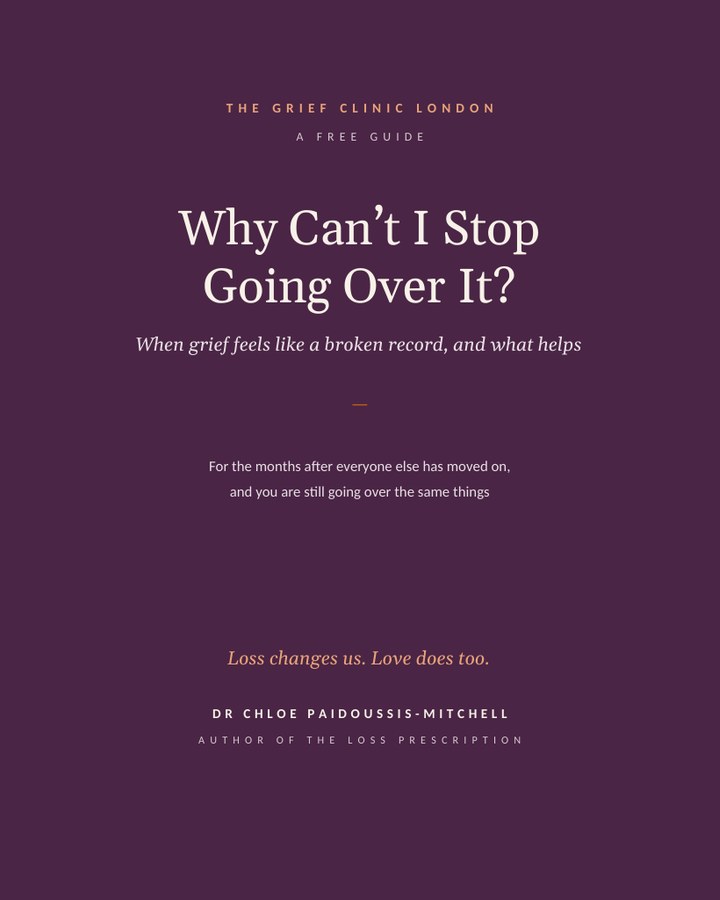
The free guide: Why Can’t I Stop Going Over It?
Why Can’t I Stop Going Over It? is a free 13-page guide: a short check-list to see if it’s for you, the four things grief circles back to and what each one is asking for, three practical steps for each, a page to come back to, and words to borrow when others have stopped listening.
By Dr Chloe Paidoussis-Mitchell, Chartered Counselling Psychologist (DCPsych, CPsychol, AFBPsS), founder of The Grief Clinic London and author of The Loss Prescription (HarperCollins). This page offers general information and is not a substitute for individual psychological care.