
Why does nothing feel normal after someone dies?
Because grief is not one feeling. It moves through the whole of you at once: your body, your mind, your heart, your relationships, your sense of who you are and what life means.
Most of us expect grief to feel like sadness. Then it arrives, and it is so much more than that. You may feel exhausted but unable to sleep. You may forget why you walked into a room. You may feel nothing at the funeral and fall apart in the supermarket a month later. None of this means you are grieving wrongly. It means grief is reaching into every part of your life at the same time.
Where does grief show up?
Almost everywhere. It shows up in the body, the mind, the heart, your relationships, your sense of self, and your sense of meaning.
- Body: exhaustion, broken sleep, a tight chest, aches, no appetite or comfort eating, getting ill more often.
- Mind: fog, forgetfulness, replaying events, trouble concentrating or making decisions.
- Heart: longing, tears, anger, guilt, fear, numbness, and sometimes relief, often all on the same day.
- Relationships: feeling apart from others, people saying the wrong thing or nothing at all.
- Self: not recognising yourself, because roles you knew yourself by have changed or gone.
- Meaning: questions of faith and purpose, and a flatness where things used to matter.
Are there stages of grief I should go through?
No. There is no timetable, and no neat set of stages you must pass through in order. Grief moves in waves, and it is personal.
Grief is a natural response to love and to change. It is not something to be pathologised or hurried. What helps is care on every front: physical, emotional, social, personal, soulful and spiritual. I think of it as caring for the whole being, not the whole doing.
What can I do today that will help?
Something small. In the early days, healing is not one big step. It is many small acts of care.
Eat one proper meal. Go to bed at the same time. Walk round the block. Give your feelings ten minutes and a page, then close the notebook. Say yes to one offer of help, and tell one person what you actually need. Cancel one thing. Light a candle, or sit by water or trees for a few minutes. Small and steady is enough. You do not have to earn rest by finishing everything first.
What do I do when a wave of grief hits?
You don’t have to solve anything. You only have to get through the next few minutes with some kindness. Try three steps: name it, notice it, nurture it.
Name it: say gently to yourself, “This is my grief.” Naming it turns a flood into something you can stand beside. Notice it: where does it live in your body right now? Feel your feet on the floor and the room around you. Nurture it: place a hand on your heart, breathe out a little longer than you breathe in, and offer yourself the words you would offer a friend.
Does this apply if my loss isn’t a death?
Yes. A marriage, a pregnancy, your health, a home, a role, or a future you had imagined are all real losses, and they deserve the same care.
Alongside any loss you may also lose routine, security, income, companionship, confidence or a sense of belonging. I call these invisible losses. Naming them helps you understand why the impact reaches so far.
When should I get more support?
Grief is not an illness, and there is no deadline for it. But please reach out to your GP or a therapist if you can barely manage day to day, or if you have thoughts of not wanting to be alive. You can call Samaritans free, day or night, on 116 123, and Cruse Bereavement Support on 0808 808 1677. In an emergency, call 999. At The Grief Clinic, our Grief Circles and one-to-one therapy are here too.
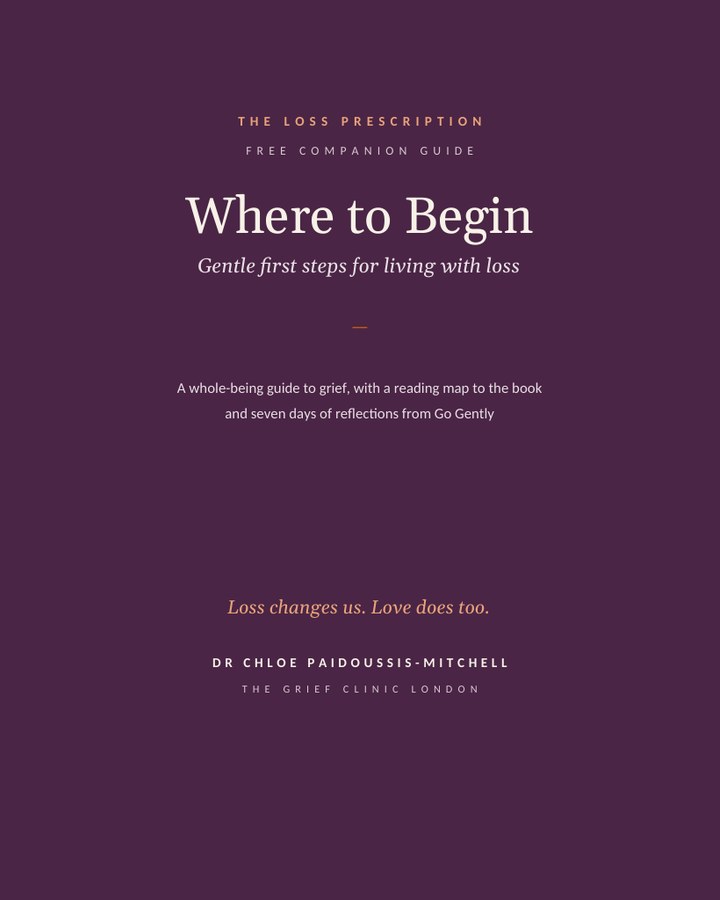
The free guide: Where to Begin
Where to Begin is the free companion to The Loss Prescription: a check-in that points you to the right chapter of the book, a whole-being care plan, a three-step practice for when a wave comes, seven days of reflections from the Go Gently journal, and a page to share with the people who want to help.
By Dr Chloe Paidoussis-Mitchell, Chartered Counselling Psychologist (DCPsych, CPsychol, AFBPsS), founder of The Grief Clinic London and author of The Loss Prescription (HarperCollins). This page offers general information and is not a substitute for individual psychological care.