
Is it OK to feel happy while grieving?
Yes. Joy in grief is not a betrayal. It is not a sign you have stopped missing them, or that you are “over it”. Joy and grief are not opposites. They grow from the same place, which is love.
Joy in grief is usually quiet: a laugh that surprises you while telling a story about them, a full breath at the end of a hard day, feeling their love still in you, warm rather than sharp. It can sit right beside sadness, sometimes on the same afternoon.
Why do I feel guilty when I laugh after a death?
Often because of a quiet belief that suffering is how we stay close to the person we lost. It comes from love. But it is not true: suffering is not the measure of love.
Love lives in memory, in ritual, in the values we carry and the way we live. You can honour someone by living fully, shaped by their loss but not erased by it. Guilt can also come from outside: our culture is uneasy with grieving people who smile. That says more about others’ discomfort than about your love.
Is it normal to go back and forth between grief and normal life?
Yes. Grief researchers Margaret Stroebe and Henk Schut describe healthy grieving as a movement back and forth: sometimes towards the loss, sometimes towards life.
This movement is not avoidance. It is how we bear something too big to face all at once. The moments of rest and lightness are part of grieving, not a break from it.
Does laughing mean I loved them less?
No. In a well-known study, psychologists Dacher Keltner and George Bonanno found that bereaved people who laughed or smiled genuinely while talking about the person who died tended to cope better over time.
Lighter moments can help us stay connected to others and to the person we have lost. Sharing a funny memory with someone who knew them is one of the warmest ways of keeping them close.
Do I have to let go of them to feel joy again?
No. Grief research now recognises that many people keep a continuing bond with the person who died: talking to them, carrying their values, feeling their presence.
When that bond feels warm, it often makes room for joy. You are not leaving them behind. You are carrying them with you.
How can I let joy back in?
Gently, and without forcing it. Start with small invitations rather than tasks.
Light a candle in their name each morning. Smell, taste or listen to something that means something. Write them a letter about a good moment. Keep a joy notebook, one small moment a week. Take a fifteen-minute noticing walk and look for three beautiful things. And keep a card where you will see it: “I am allowed to feel joy. It does not mean I have stopped grieving.”
When should I get more support?
Grief is not an illness, and there is no deadline for it. But please reach out to your GP or a therapist if you can barely manage day to day, or if you have thoughts of not wanting to be alive. You can call Samaritans free, day or night, on 116 123, and Cruse Bereavement Support on 0808 808 1677. In an emergency, call 999. At The Grief Clinic, our Grief Circles and one-to-one therapy are here too.
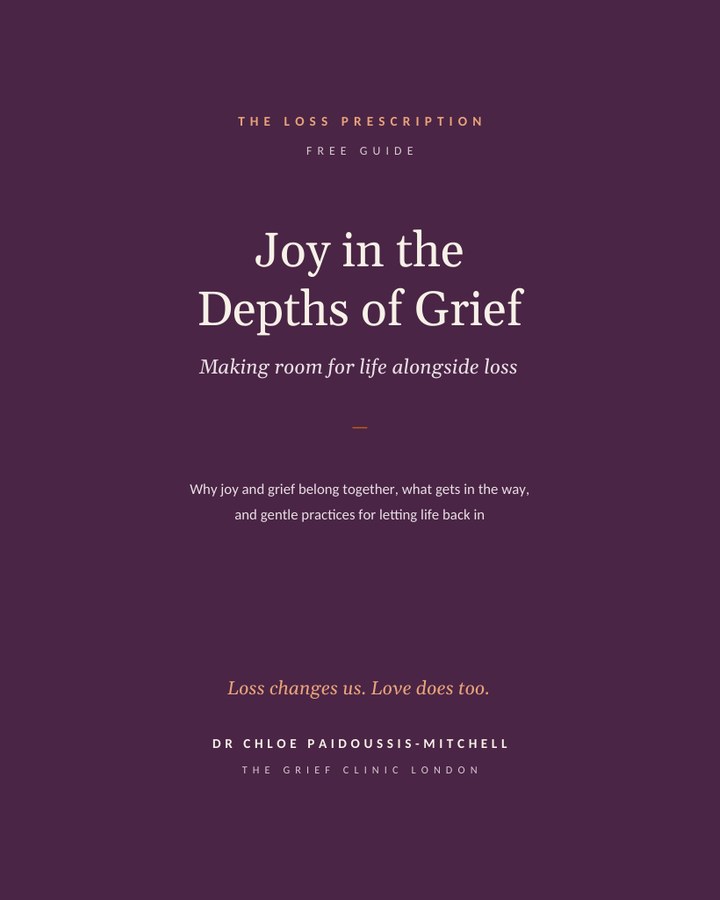
The free guide: Joy in the Depths of Grief
Joy in the Depths of Grief is a free guide: what joy in grief is and isn’t, why grief and joy belong together, the guilt of feeling better, joy and the body, soulful joy, seven small practices, and how grief and joy settle side by side over the years.
By Dr Chloe Paidoussis-Mitchell, Chartered Counselling Psychologist (DCPsych, CPsychol, AFBPsS), founder of The Grief Clinic London and author of The Loss Prescription (HarperCollins). This page offers general information and is not a substitute for individual psychological care.